- © 2026 Annapolis Home Magazine
- All Rights Reserved

by Gary Jobson
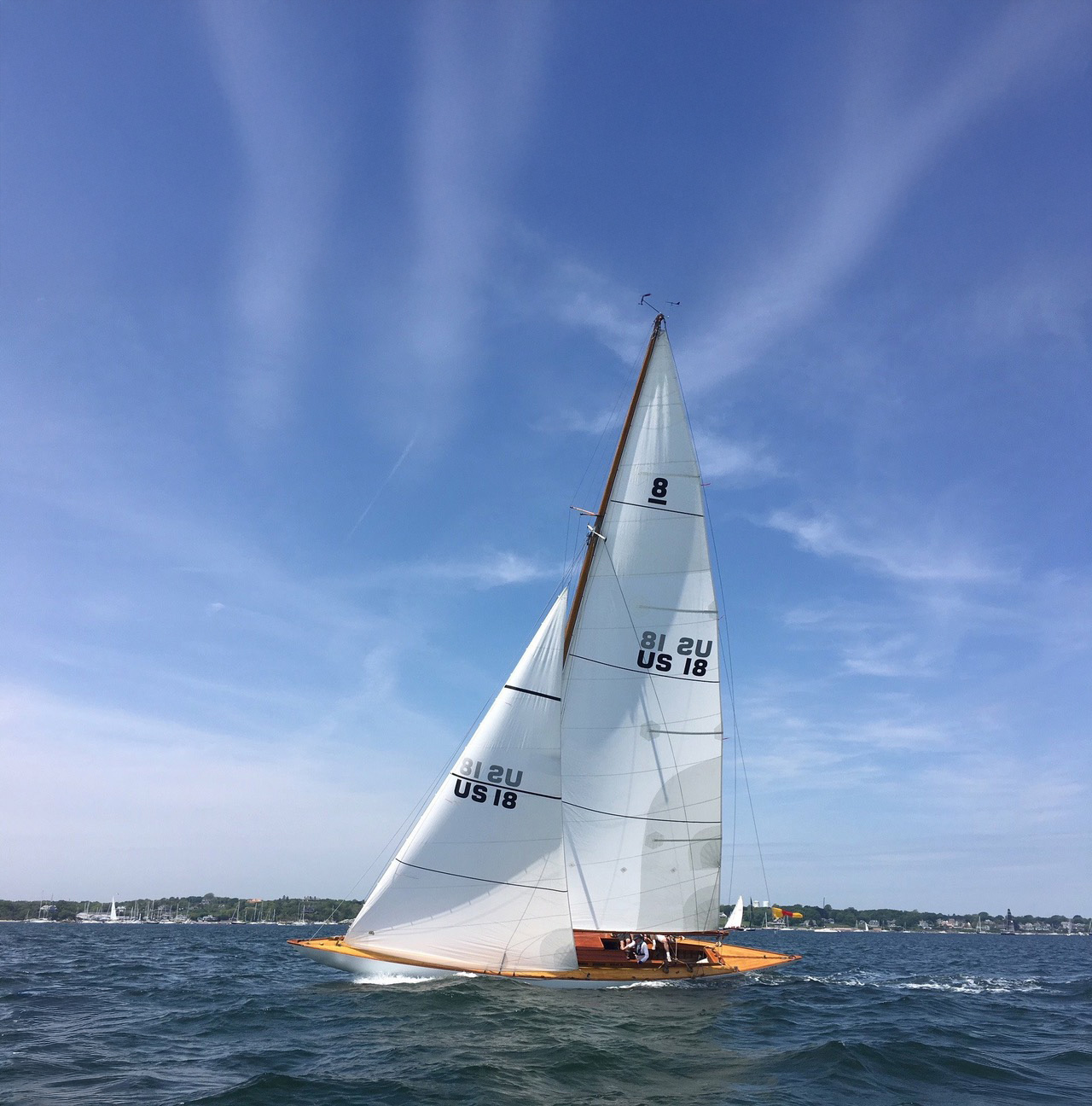
The 48-mile sail from Edgartown on Martha’s Vineyard to Newport, Rhode Island, was exhilarating. The wind was blowing hard at 18-23 knots on that warm August day. The locals call this wind condition a “Smoky Southwester.” I felt lucky to be steering this remarkable Olympic champion sailboat, named Angelita, which had won a gold medal in the 1932 Olympic Games. The waves were big, and Angelita sailed easily over and through the choppy seas. I felt like the skies and sails over my head, my body sitting on the rail with my hand on the tiller, slicing through the sea, all existed as one. The boat was in a groove and sailing at 9 knots. Our crew was comfortable and happy.
Angelita was built in 1928 by owner Owen Churchill (1896-1985) with the singular purpose of winning a medal in the Olympics scheduled to be held in Los Angeles four years later—the first time the United States was to participate in yachting in the Games. He named the boat Angelita in honor of the host city. (Churchill is noted for inventing and patenting the swim fin, which has been popular with swimmers ever since.) The boat is an 8-metre Class, created at a yachting conference in Great Britain in 1907. The concept at the time was to establish different design and measurement parameters to allow boats to compete on a level basis. The 8-metre was used in Olympic competition from 1912 to 1948. Angelita was the first American boat to win a gold medal in the 1932 Olympic Games. It was a successful yachting event for the USA, in which we won two gold medals and one silver. In fairness, only one other 8-metre participated, representing Canada. Churchill later took Angelita to Kiel, Germany, for the 1936 Olympic Games, but sadly finished tenth in a ten-boat fleet.
The boat was originally designed by Nicholas Potter and built at Wilmington Boat Works in California. The hull is double-planked, mahogany over cedar, with oak frames and cedar decks. Potter started his career working with the famous three-time winner of America’s Cup, naval architect W. Starling Burgess, in the offices of the Herreshoff Manufacturing Company in Bristol, R.I. In the early 1920s, Potter headed to California to set up his own naval architecture practice. His unique design for Angelita was known as a “double ender,” with both a narrow bow and stern. Angelita is 50 feet long and carries a generous 800 square feet of sail area. In a strong blow, the boat can be a handful for six crew.
For the 1984 Olympic Games in Los Angeles, Peter Ueberroth, the Chair of the Los Angeles Organizing Committee, gave Churchill and Angelita special recognition by restoring the boat and putting it on display at the Games. Several years later, two American sailing enthusiasts, Samuel W. Croll III and Henry Skelsey, acquired Angelita and have been racing her in the classic yacht circuit ever since. As wooden boats need a major restoration about every thirty years, the owners commissioned a complete renovation of Angelita in the winter of 1996-97—right down to the frames.
I was honored to be invited to race Angelita for a series of regattas in New England. Our first event was the New York Yacht Club Annual cruise, followed by Nantucket Race Week, and finally the famous Opera House Cup on Nantucket Sound. Angelita won Nantucket Race Week, placed third out of 37 boats in the Opera House Cup, and received admiration at every port.
The boat looks both elegant and purposeful. The owners adhere to the importance of tradition and keep her in Bristol condition. Sailing this boat is old school; she is not filled with modern electronics and mechanical gear. Angelita is narrow at 8 feet, 8 inches, but has adequate headroom and is nicely appointed with four comfortable bunk beds, a head, and a galley.
Henry Skelsey manages a private equity firm. He and his wife Susan live in Rye, New York, in a house once owned by John and Margaret Mitchell, who were very often in the news during the Nixon and Ford administrations. Sam Croll and his wife Anne divide their time between Connecticut, Florida, and Nantucket. He is a graduate of Yale University Divinity School and manages a company that supplies engineering services for ocean-going cargo ships. For several years, Croll served as Chair of the Library Committee of the New York Yacht Club, further validating his interest in preserving the history of yachting. Both men have a passion for sailing and seem happiest aboard their beloved Angelita.
Late in the afternoon on that August day, Angelita arrived in Newport after six hours of sailing. We set a spinnaker that sported the Olympic rings as we entered the harbor. I’m sure Owen Churchill would be proud of his iconic boat 95 years after being built.


© Annapolis Home Magazine
Vol. 17, No. 2 2026