- © 2026 Annapolis Home Magazine
- All Rights Reserved

Story and Photography by Robert E. Haywood
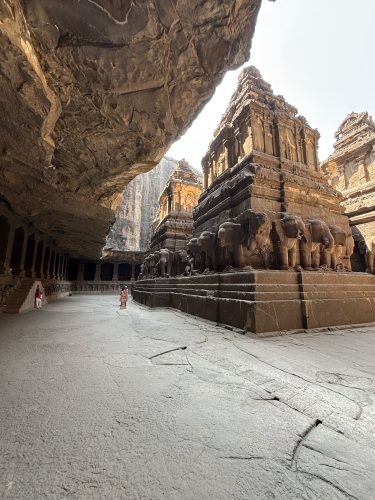
The Gajendra Peeth (elephant plinth) forms part of the temple’s base, with the sculpted elephants appearing to serve as a load bearing foundation.
We traveled to India partly to experience the extraordinary Ajanta and Ellora Caves in Maharashtra. As we hiked toward these mysterious ancient caves, we sensed that we were about to encounter something incredible—something that would inspire awe and wonder. And wonder is precisely what we felt. The Ellora Caves are among the largest and most remarkable rock-hewn monastic and temple complexes in the world.
The classic tourist route in India takes you through the “Golden Triangle,” which includes the capital city of Delhi, Agra (home to the Taj Mahal and Agra Fort), and then Jaipur—known for its palaces, forts, and its nickname, the “Pink City.” These destinations are all spectacular in different ways and well worth visiting.
However, when planning our trip, we found that traditional Golden Triangle itineraries typically do not include Maharashtra, where the Ajanta and Ellora Caves are located. Reaching them involves additional domestic travel, including a flight to Chhatrapati Sambhajinagar, formerly known as Aurangabad.
Ellora comprises over 100 caves, 34 of which are numbered and open to the public. Representing three major religious traditions—Buddhism, Hinduism, and Jainism—their coexistence at the same site makes Ellora an exceptional expression of the religious and cultural diversity of ancient India.
The complex was created over several centuries, with the earliest excavations dating to roughly the 6th century and the later Jain caves dating primarily to the 9th and 10th centuries.
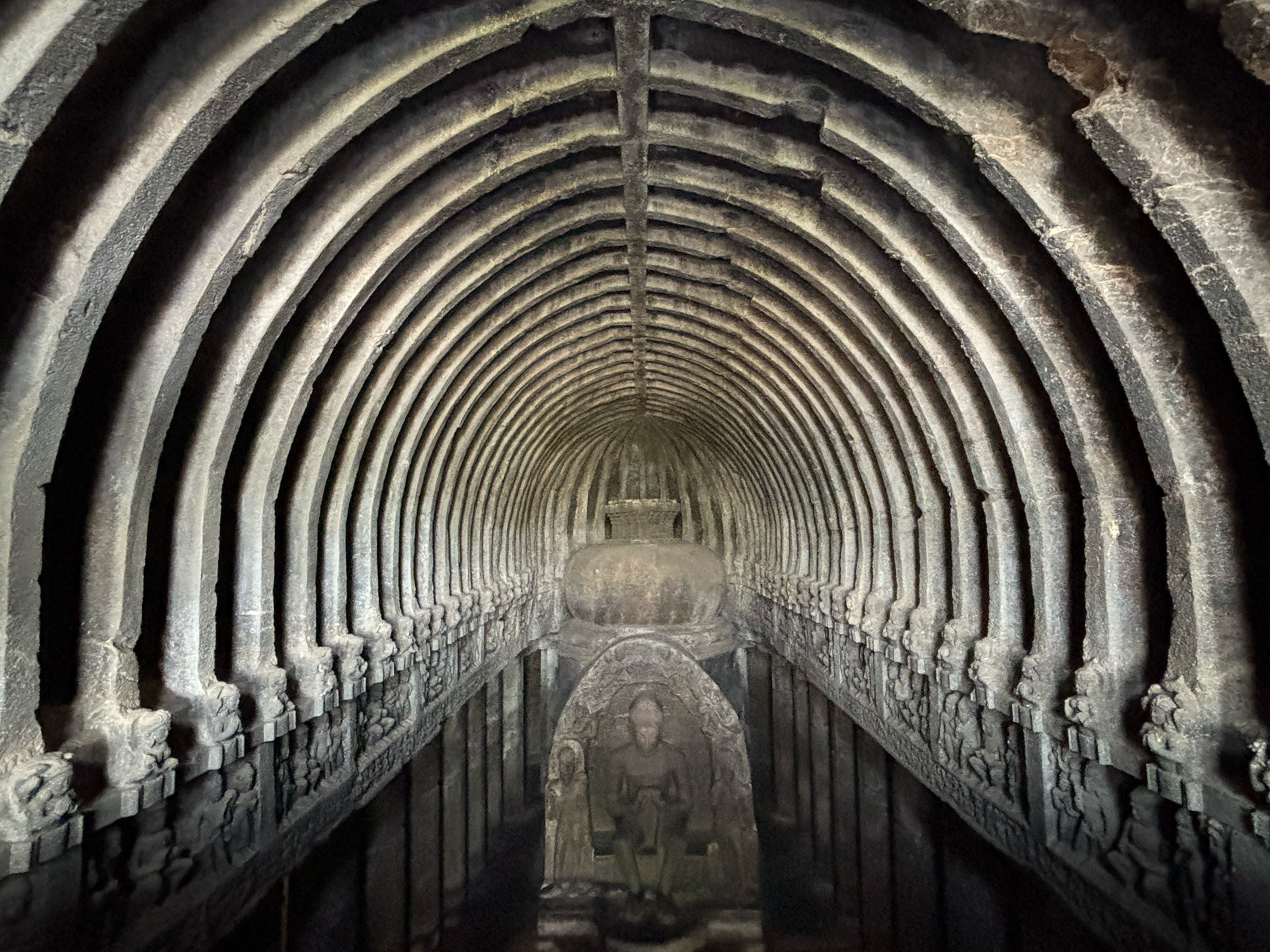
The Buddhist highlight is Cave 10, the Vishvakarma Cave, also known as the “Carpenter’s Cave.” The Buddhist caves include monasteries, or viharas, and Cave 10 is the site’s principal Buddhist chaitya, or prayer hall. When we visited, we saw Buddhist monks, barefoot and dressed in orange robes, visiting the caves, and heard their chants echoing through the ancient stone halls.
The cave’s monumental arched ceiling is carved to imitate the ribs of a wooden structure, creating the appearance of
timber construction. At the rear of the prayer hall is a grand seated Buddha carved into the rock. The Buddha is accompanied by bodhisattva figures, including Avalokiteshvara, associated with compassion, and Maitreya, associated with the future Buddha.
The sculptors worked with iron chisels, hammers, and other tools to transform the hard basalt into sculptural architecture of profound intricacy and complexity.
Cave 16, the Kailasa Temple, is an enormous Hindu temple dedicated to Shiva. The Kailasa Temple is traditionally attributed to the powerful Rashtrakuta king Krishna I, who ruled approximately from 756 to 773 CE. Considered one of the most ambitious rock-cut monuments ever created, the temple was excavated monolithically from a single mass of basalt.
The carvers worked principally from the top down, removing rock to create the temple and its surrounding courtyard. Its enormous courtyard, towering architectural forms, elaborate columns, and sculptures depicting Hindu deities and scenes from mythology are stunning in both scale and detail.
This is especially evident in the majestic stone elephants, breathtaking in their realism and depiction of movement, as if living creatures were about to step out of the rock. The Gajendra Peeth (elephant plinth) forms part of the temple’s base, with sculpted elephants appearing to serve as a load-bearing foundation and creating the illusion that the colossal structure is supported on the backs of these sacred animals.
For any student of history, art and architecture, and sheer human ingenuity, the Ellora Caves are a must-see. It took me more than forty years to finally see them. That is why I write about travel—to spread the word.
For an excellent scholarly book of Ellora, see Deepanjana Klein and Arno Klein, Ellora: Cross-Fertilization of Style in the Buddhist, Hindu and Jain Cave Temples, Mapin Publishing, 2006.
UNESCO, the United Nations Educational, Scientific and Cultural Organization, Ellora Caves, www.unesco.org.
© Annapolis Home Magazine
Vol. 17, No. 5 2026