- © 2026 Annapolis Home Magazine
- All Rights Reserved

by Kymberly Taylor
Photography by Anice Hoachlander
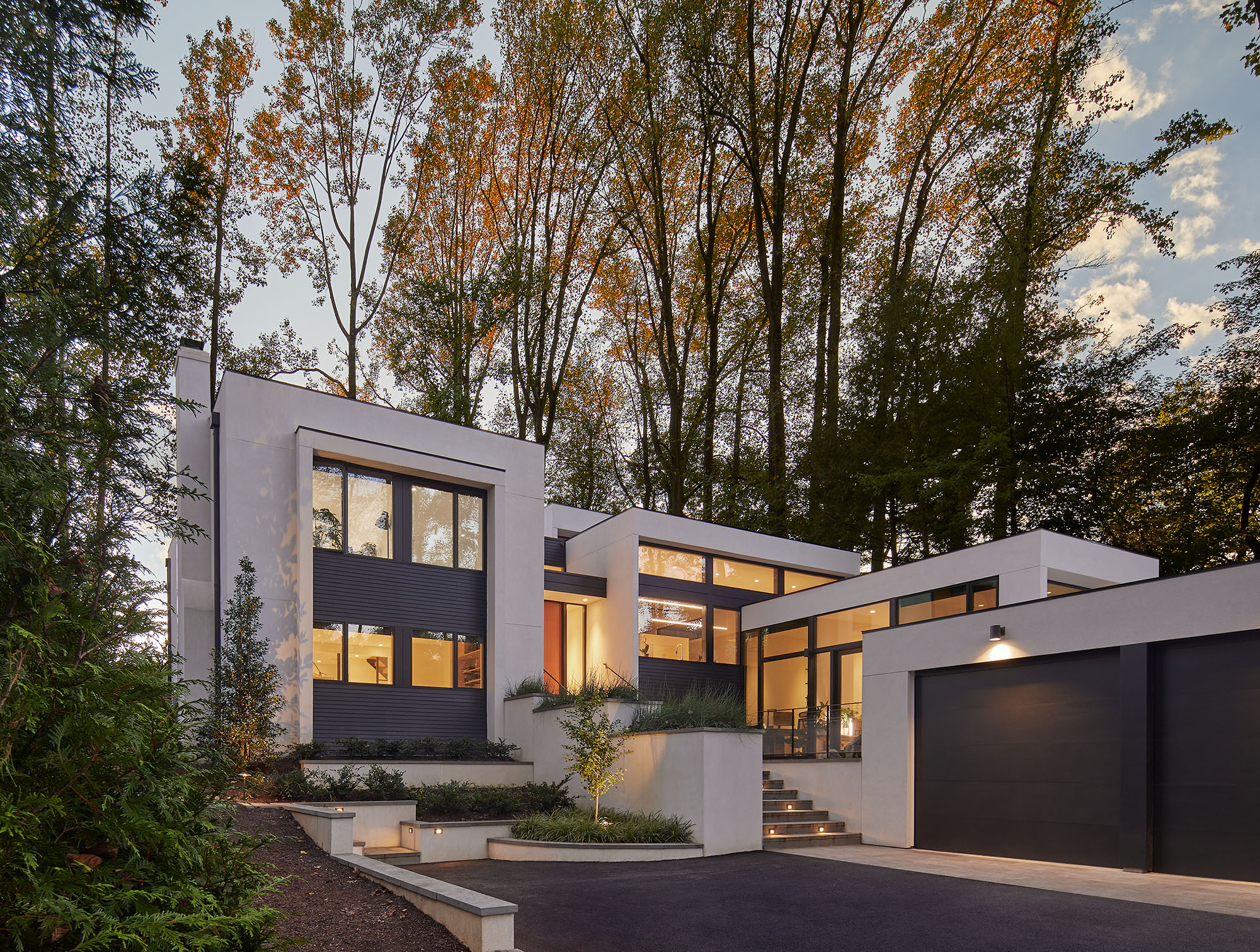
“ It was a house in two parts; one went away.” – Mark McInturff
In a rolling neighborhood packed with traditional architecture, a contemporary home nestles into the side of a hill, veiled by a stand of poplars. Designed by architects Mark and Jeff McInturff with landscape architect Lila Fendrick, a sequence of stepped levels follows the contours of the land. With a distinct Asian design sensibility, interior spaces with clean lines flow smoothly from high levels to low. In minimalist rooms, a few plush furnishings rise like friendly islands in a calm sea.
This is the home that Kacy Yang and Tian Xia, both born in China, have loosely envisioned ever since they got married. With Tian’s assistance, Kacy managed the interior design and hand-selected many of the furnishings from China and other Asian countries. As you stare up at a 16-foot ceiling, you would never know this light-filled atrium was once a humble split-level from the 1970s. The couple bought the home for its “good bones” and moved in during Covid before their major remodel.
When it came to the exterior, they knew they wanted “modern,” but were not sure how to get there. Mark and his son Jeff listened and got to work. They literally cut the original split-level in half and tore off the right side, explains McInturff. “It was a house in two parts; one went away,” he says. The “old” half was simply renovated, with a family room on the lowest level and bedrooms on the second. The new half was enlarged, replaced with a sequence of stepped-down volumes, and lit on three sides by clerestory windows, explains Mark. They moved the garage further away from the house and, at the farthest end of the new wing, inserted a pair of small offices.
A vestibule between them steps out to a hutong, which is a small inner-facing courtyard common to homes in Beijing. The design is similar to one in Kacy’s great-grandmother’s home. The adjoining garden is inspired by Zen temple gardens that Kacy discovered during her travels, especially in Kyoto, Japan.
The airy, wide-open rooms in the interior are well-suited for the couple’s Asian design aesthetic. Tian, who is from Chengdu, Sichuan Province, said, “We were inspired by Japani, which blends Asian modern with Scandinavian clean lines.” To Tian, comfort was especially important. “I asked him what he wanted, and he showed me furniture from The Four Seasons,” recalls Kacy. This is evident in the great room’s resort-style low couches arranged for conversation, much like the interior of a 5-star hotel.
The home has an abundance of light wood, which was a deliberate choice. White pine floors add warmth and unify this home. “The first wood you start with is the wood you should end with. We don’t need to have a wood festival. That whole attitude is very Scandinavian and also Japanese,” says Mark.
The floorplan mirrors the couple’s lives on several levels. For example, both Tian and Kacy work in the tech field. A user-experience designer, Kacy ensures that a corporation’s website is easy to navigate. She says she applies the same principles to her home. “Usability is a big part of us. The house has to be beautiful; it has to be our space. When it was being designed, we knew we wanted a gaming station, a place to chill, and the offices. And because we have separate work spaces, we wanted a ‘family-get-together space’ downstairs.”
The couple received what they wanted and more. The main living area is one giant space with a wall of windows overlooking the forest in the backyard. This room is divided by a single distinct wooden cabinet, a blend of Scandinavian beauty and practicality. Designed by Jeff, the cabinet is basically a free-standing multi-functional wall; storage drawers and closets hide all clutter from view. Ingeniously, it contains major kitchen appliances on one side—including ovens, a coffee maker and warming drawer—and a fireplace on the other.
The rest of the space has only essential furnishings. There is a traditional tea table in one sunlit nook and couches that Kacy hand-selected from her father’s furniture factory in China. The Asian atmosphere is especially deepened by two art pieces in the main room. The first is a folding screen Kacy painted in an abstract design with a black and gold palette. The other is by a painter in China. Chinese characters state, “Mind over matter. When you have mind over matter, you will achieve ultimate freedom.” Gesturing to the sun-washed room animated by two frisky airborne cats, she says, “That is kind of my motto here.” Her cats, named Miso and Tofu, are Persian Munchkins. Distinguished by very short legs, they travel low to the ground, much like miniature magic carpets. They have a special interactive play rug and lounging cushions in almost every room.
One steps down to the lower level, which has the feeling of a cozy den, with a separate space for an office and gaming. The staircase is framed by geometric glass panels sandwiched between and enclosed by pieces of steel designed by Jeff. “It was a challenge because first I presented them with a wood lattice railing,” he recalls.
The architecture seems detached from its well-behaved neighbors. Yet, its open concept is paradoxically intimate. Spaces can adapt and shapeshift, reflecting the personalities, passions, and eccentricities of those who live inside. This is indeed what Mark hopes to achieve with his clients. “At the end of the day, I want to design houses that look like them,” he says.
Sometimes, glass and steel structures are perceived as cold and impersonal. However, Kacy and Tian prove this theory wrong. The architecture and interior of their new home make them happy. It is that simple and that complex. Beloved objects from China animate rooms with the energy of origin. Private and communal spaces, with tea tables and gaming zones, bring joy to each day. Even the Persian Munchkins are satisfied. There is something special, even magical, going on in this logical home—Kacy and Tian, with their user-friendly and comfort-driven objectives, give “purposeful design” an extra fresh meaning.
“ The first wood you start with is the wood you should end with. We don’tneed to have a wood festival. That whole attitude is very Scandinavian and also Japanese.” – Mark McInturff


ARCHITECT: Mark & Jeff McInturff, McInturff Architects
CONTRACTOR: Acadia Contractors, Inc.
LANDSCAPE ARCHITECT: Lila Fendrick Landscape Architects
AUDIO/VISUAL: SmartTouch USA
© Annapolis Home Magazine
Vol. 17, No. 2 2026