- © 2026 Annapolis Home Magazine
- All Rights Reserved

By Kymberly Taylor
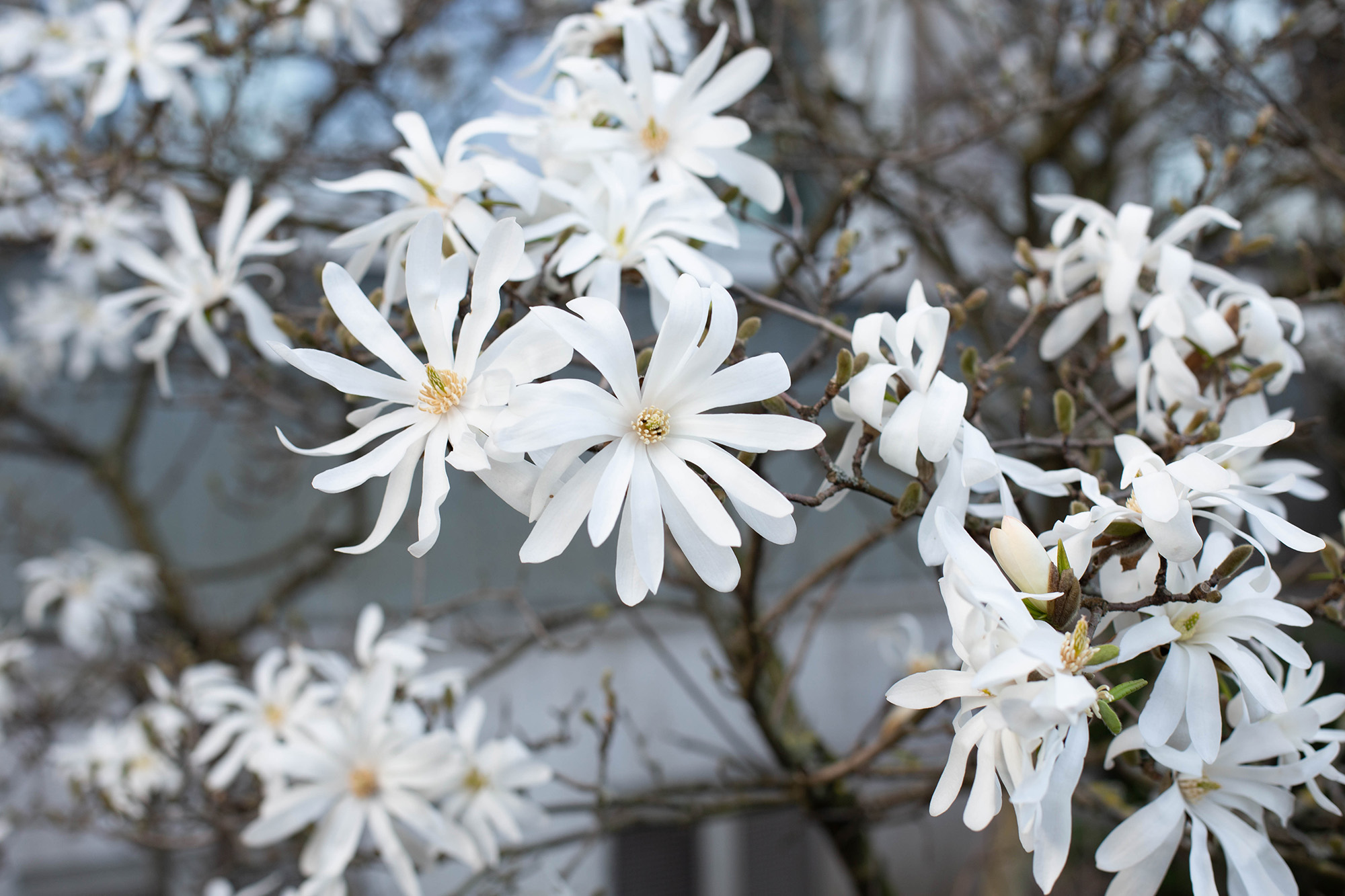
In the soft darkness of late winter, the Star magnolia’s sleeping flower buds catch the eye. Covered in silvery fur that insulates the buds from the cold, Magnolia stellata’s star-shaped flowers will soon unfold, even before foliage appears. Without leaves to interfere with the view, its blossoms create a sparkling, meteor-like show that lightens the heart and seems unworldly at the same time.
Hold one in your palm and examine the long, slim, pure white petals. While breathing in its fragrance, envision a young earth filled with steaming jungles and a 25-foot-tall Alamosaurus (the size of a house) feeding on its leaves. According to the Harvard Arboretum, magnolias, including the Star magnolia, are one of the most primitive flowering plants, with fossil records dating back over 95 million years, including the Cretaceous period when dinosaurs dominated the continent. This makes them older than bees and butterflies. In fact, they were first pollinated by beetles. Native to Japan, its tendency to flower early without leaves is called “precocious flowering,” an evolutionary strategy to attract early pollinators before leaves obstruct the blossoms.
My mother’s Star magnolia amazes us both. Silhouetted by the Magothy River, it is always the first shrub to bloom, becoming a still life painting in the austere landscape. At first, I thought this small tree was a pussy willow as its branches were covered with fuzzy corns as soft as kittens. However, as these buds swelled almost imperceptibly with every passing day, releasing blossoms emitting a luscious perfume, I realized they revealed something I needed: patience. After flowering in late spring, buds form but remain dormant for almost a year. In late February, the right temperature coaxes them into the world just in time to feed pollinators, ensure their own survival, and lift us with their ice-white beauty. Humans, pollinators, and our planet receive what we want and need simultaneously. This unconscious harmony fills the crisp winter air with power.
If you have space for this slow-growing compact shrub, treat yourself and buy one! The Star magnolia does especially well in Maryland, as it is low-maintenance, exceptionally hardy, and deer-resistant. Plant in deep, acidic soil in full sun and prune after flowering. Propagate by taking root cuttings after the flower buds have formed. In this simple way, you can share your Star with friends and celebrate its expanding skies.
Note: Native to Japan’s Honshu highlands, the Star magnolia has a fragrant “precocious” 3- to 4-inch pure white flower that transitions to light pink.
© Annapolis Home Magazine
Vol. 17, No. 1 2026