- © 2026 Annapolis Home Magazine
- All Rights Reserved

by Kymberly Taylor
“Coevolutionary synchronization has evolved over millions of years, revealing how native plants and pollinators are deeply dependent on one another.”
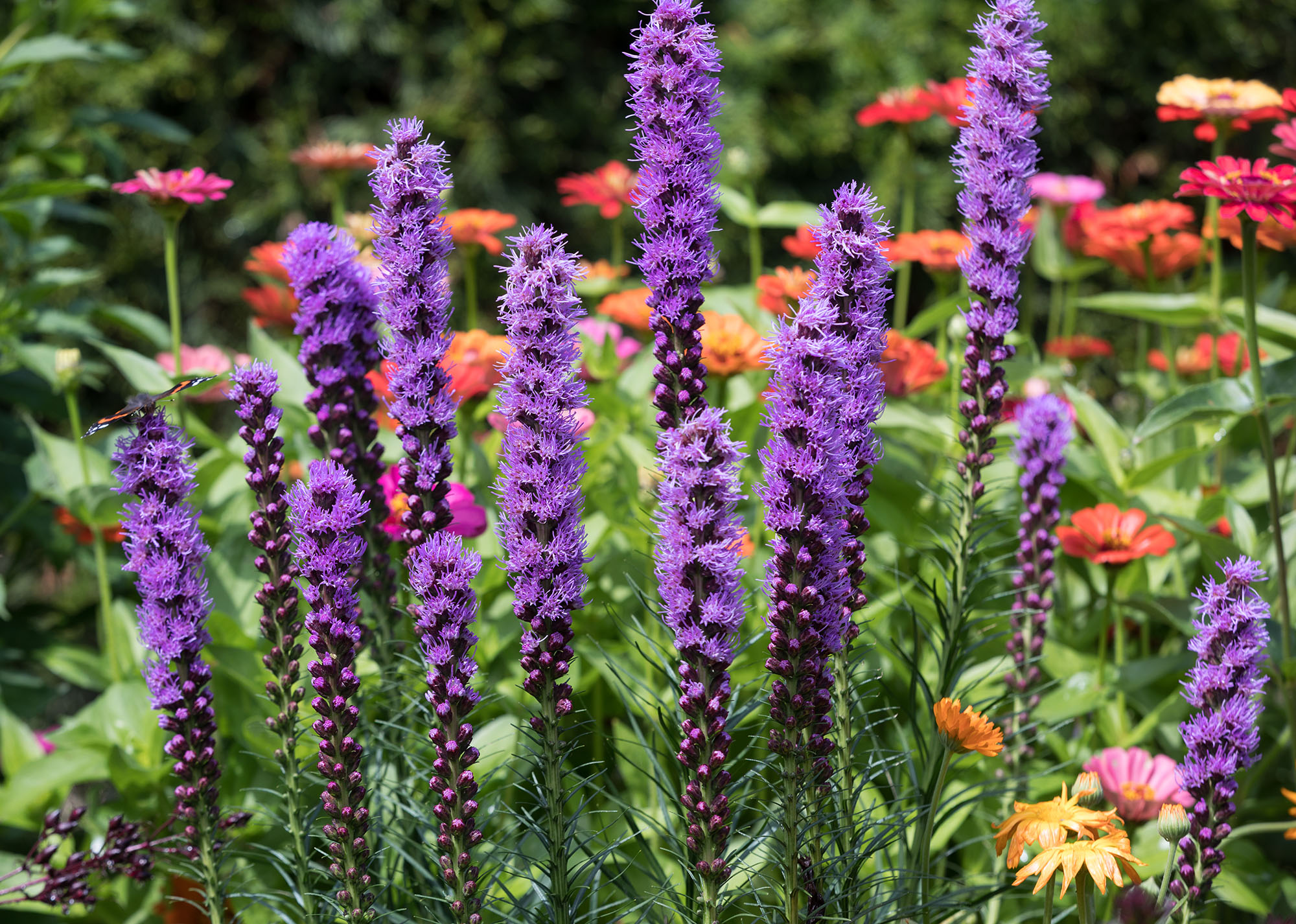
 I have noticed, over time, that native plants give my garden an extra-special dimension. Each one is like a wise elder, quietly beautiful and industrious, with a story to tell that connects me to the ground beneath my feet. When I came across the dazzling Liatris spicata, with its tall feathery wands studded with seductive purple flowers, I dismissed it as a fancy European cultivar. When I learned that Dense Blazing Star was actually a wildflower native to the prairies of North America, I knew I had to make room for it in my garden.
Dense Blazing Star, also called Gayfeather and Marsh Blazing Star, grows up to five feet tall in full sun in average soil and has many fascinating features. Its distinct flower spikes bloom slowly from the top down rather than from the bottom up, creating a feathery “bottlebrush” appearance. Botanists call this unique floral structure “determinate inflorescence.” This design is intentional! Because Liatris blooms sequentially, rather than all at once, it provides nectar for a longer period of time and benefits more pollinators.
Dense Blazing Star belongs to the Asteraceae family, which evolved approximately 83 million years ago during the dynamic Cretaceous Period. Liatris is a much younger, highly specialized genus that emerged during the Cenozoic Era, in response to the changing North American climate and the rise of open prairie ecosystems. The flowers have no detectable fragrance, yet emit chemical compounds designed to attract the very same butterflies it evolved alongside. These include some of our largest lepidopterans: Monarchs, Swallowtails, and Fritillaries. Scientists note that this is a prime example of coevolutionary synchronization, where two or more species develop a symbiotic relationship and evolve special traits over time to ensure reproduction.
Here are a few examples: Monarchs, Swallowtails, and Fritillaries have tongues long enough to reach the nectar at the bottom of Liatris’ tubular flower, and Dense Blazing Star blooms primarily in August, just when the Monarchs are preparing for their long migration south. Because this plant blooms from the top down, it creates a “landing pad” for the larger butterflies to land upon and thus, extract pollen more efficiently. This synchronization has evolved over millions of years and reveals how native plants and pollinators are almost divinely “paired” and deeply dependent on one another. There is more to love about this powerful perennial. Like many blue and purple flowers, the blossoms of Dense Blazing Star emit and reflect ultraviolet (UV) light to attract pollinators. In fact, the plant’s colorful blooms create a UV “halo” that is invisible to the human eye but a beacon to bees and other insects, directing them straight to the source.
According to the North American Ethnobotany Database and researchers at Ohio State University, this bright wildflower, indispensable to certain butterflies, was highly valued by indigenous North American tribes for its medicinal properties. The Cherokee used the roots as a pain reliever for back pain and limb aches, while the Cheyenne burned the roots as incense to treat headaches. The Menominee prepared remedies from the plant to address heart issues.
Liatris returns reliably, even after harsh winters. Because it grows from a corm, which is something between a root and a bulb, it can store water and nutrients underground. It is no surprise that, in floriography, the language of flowers, Liatris means “I will try again.” Let us all plant Dense Blazing Star in the garden! These trusty blooms wisely remind us to rise again when troubles get us down, and to continue to work towards our dreams, however crazy they may be. I say this because, when you stop to consider this wildflower’s properties, right down to its invisible light, undetectable aroma, and disappearing blossoms that form a special landing pad for the giant Monarch, it is clear that a divine power is involved, producing a masterwork almost beyond imagination.
© Annapolis Home Magazine
Vol. 17, No. 4 2026